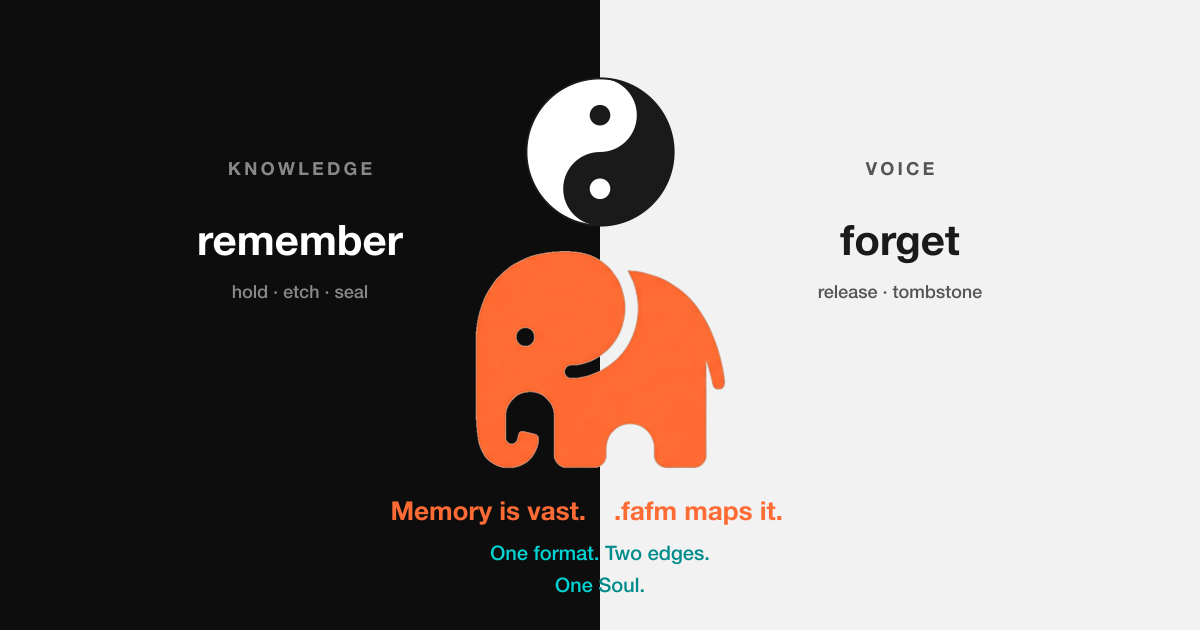
TL;DR: Memory is vast. A human lives in the tension between what must be
remembered and what must be forgotten — often with a cost either way. AI does not erode
like flesh… until we build systems that can forget on purpose. .fafm is
double-edged by design: knowledge and voice. Our job is a
format that has already shown it can map both sides — to aid human and machine in the
AI era, with unerring consideration for past, present, and future.
The human tension
You already know this in your bones. There are things you need to remember — a partner’s anniversary (a deadly miss for the unlucky male, as tradition and comedy both agree). There are things you need to forget — a bad experience that still arrives uninvited at 3 a.m. Remembering has a cost when you fail. Forgetting has a cost when you cannot.
That is not a product requirements document. That is the human condition. Any memory system that only ever appends is lying about half of life. Any system that pretends delete is secure erase is lying about the other half.
Time erodes us. Does it erode AI?
Biological memory is soft. Time softens edges, rearranges emphasis, mercifully blurs some nights and cruelly sharpens others. AI memory, left alone, is hard: bits do not fade; context windows fill; logs and vectors and “memories” accumulate until the past is a warehouse with no fire exits.
Or do they fade?
Here is the gray area. Models forget when you truncate the window. RAG “forgets” when you never retrieve a chunk. Vendor memory “forgets” when the product ships a new store and the old one is not migrated. That is not forgetfulness — that is accident, product churn, or absence mistaken for policy.
A grown-up format has to say the quiet part out loud: what does forget mean? Not “we hope the merge doesn’t resurrect it.” Not “the UI hid the row.” Lattice truth: delete is state (tombstones travel). Debt is visible. When the graveyard must be paid, epoch compact breaks lineage on purpose so lagging peers cannot silently resurrect the dead — refuse, don’t hope. Compact is not secure erase. Time does not “naturally” clean an AI’s soul unless you design the law.
So: AI does not erode like we do. Unless we give it laws that honor both holding on and letting go. That is not philosophy bolted onto a feature list. That is the requirement.
Yin and yang — one media type
.fafm (application/vnd.fafm+yaml) is one IANA-registered format
with two profiles — not two products that happen to share a logo.
Knowledge
Typed, cross-linked agent memory. Etch. Recall. Forget. Debt. Compact. The lattice arc that just closed a hard cut: Forgettable, then Compactable. Reference: claude-fafm-sdk · Compactable.
Voice
The Voice Memory Layer — so the assistant remembers you across calls. Conversation first; consequence (hide / archive / delete) belongs in UI, never a misheard command. Reference: grok-faf-voice · VML.
That is the yin-yang. Same soul file. Same verbs at the core. Different surfaces for how humans meet the machine — keyboard and runtime on one edge; spoken presence on the other. PM.IR. — Permanent Memory. Instant Recall. — was never a single-SDK slogan. It was the thesis of a vast medium.
Focus was a gift
We just finished a pure knowledge cut — Compactable on claude-fafm-sdk — as if Voice did not exist for a while. That was not
forgetfulness of the other edge. That was how you finish a lattice law without diluting
it. Only when the knowledge edge holds can you turn and say, honestly: Memory is vast.
The other edge is still here.
Voice still means: we will not casually erase you mid-conversation. Knowledge now means: when forget is required, it converges; when debt is paid, it is deliberate. The format has to be strong enough for both morals without forking into two incompatible files.
Past, present, future
- Past — what was etched and sealed; packets and namepoints that already traveled; archives before compact; the human history we refuse to romanticize or sanitize into “wipe.”
- Present — the live soul: what is observable after tombstones; what voice can say in this call; what an agent can recall without lying about the join.
- Future — lagging peers, new devices, epoch barriers, optional watermark when frontiers exist; multi-writer horizons not yet frozen. Always the same north star: forgotten stays forgotten, or the merge refuses — never silent resurrection.
Our job is not to maximize tokens stored. It is to maximize memory for the AI era — usefulness, portability, honesty — with unerring consideration for that full timeline. Aid the human who must remember an anniversary and must release a scar. Aid the AI that must hold project truth across models and still let a secret stay dead after forget.
What the format already demonstrated
.fafm is not a pitch deck. It has already shown, in shipping code and frozen
spec:
- One media type, two profiles — no fork
- Offline-first soul file; optional hosted namepoint
- Dual transport (packet + hosted) under one merge law
- Convergent forget (tombstones) and deliberate compact (epoch)
- Honesty bounds: lattice marker ≠ secure erase; compact ≠ wipe
That maps both sides of the blade — remember and forget, knowledge and voice — not a feature checklist pretending to be a philosophy.
Read more
- PM.IR. — Permanent Memory. Instant Recall. — the dual-profile launch thesis
- The Voice Memory Layer — voice edge
- Forgettable Memory · Compactable — knowledge lattice arc
- memory.faf.one · claude-fafm-sdk · grok-faf-voice