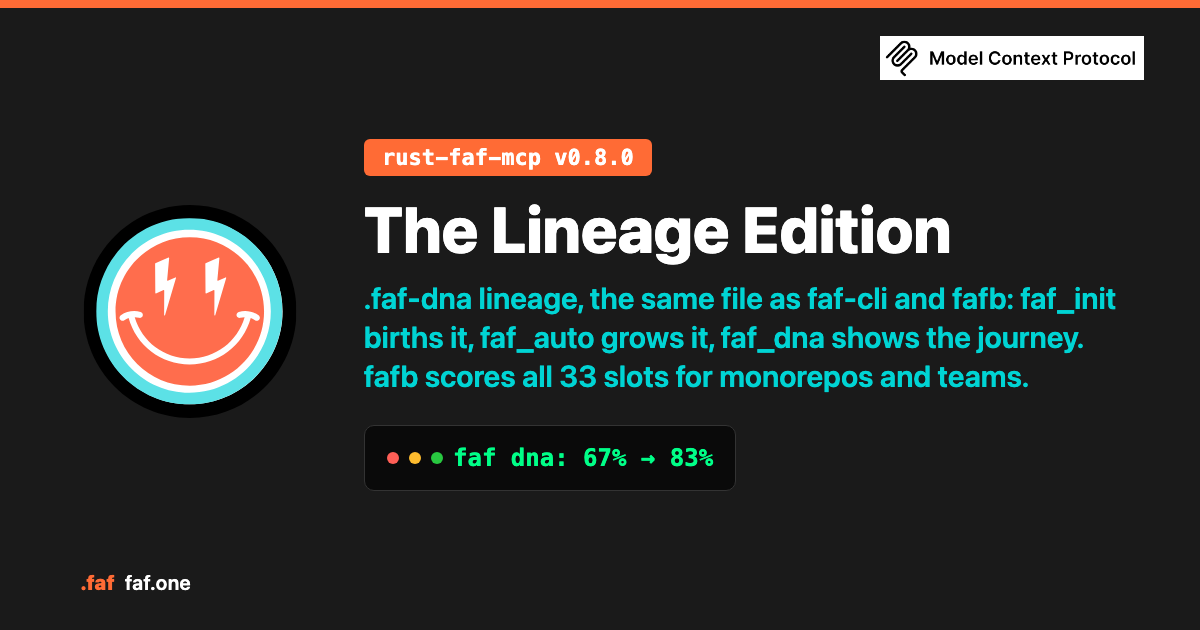
TL;DR: your project's AI-context score now has a birth certificate and a
journey, in one .faf-dna file that faf-cli, FAFb and rust-faf-mcp all read and
grow. rust-faf-mcp 0.8.0 adds faf_dna (12 tools). And building on the success of
faf-cli, FAFb is the full Rust version, for teams. Help us finish the launch.
In Plain English
Old state. faf-cli kept your project's lineage: the first score, every step up, the journey. The Rust tools didn't. Switch from faf-cli to FAFb or rust-faf-mcp, and the story stopped.
Fix. One file, one format (faf-dna-v1), written byte for byte
the same by all three. Each tool adds to a lineage the others wrote. A file none of them wrote
is read and left as it is.
New state. Start the lineage in any tool, grow it in any tool, and read the same journey in every tool.
cargo install rust-faf-mcp --version 0.8.0Cargo is the install. The first hit compiles the Rust deps once. To try it
without a Rust toolchain, point your MCP client at npx --yes rust-faf-mcp@0.8.0.
One lineage, three tools
We ran it on a copy of a real repo, passing the same .faf-dna between tools:
- faf-cli
faf initwroteproject.fafand its birth certificate: 67%. - We filled a W (
why). rust-faf-mcpfaf_autorecorded the growth: 75%. - We filled another (
who). faf-clifaf autorecorded it again: 83%.
Then faf-cli faf dna and rust-faf-mcp faf_dna printed the same lines:
67% → 83% Birth DNA 67% (born 2026-09-13) · current 83% · growth +16%FAFb reads and grows the same file too (0.9.4, faf dna).
Why a lineage
The birth certificate is the honest first score, even 0%. Growth from there is the demonstrated value of FAF: every version records its score, what changed, and when.
It stays honest. Growth never touches the birth certificate: each new score is added as a new
version, and the first score stays. And a tool only adds to a .faf-dna it can
prove it wrote. Anything else it reads, leaves alone, and says why.
21 slots, 33 slots
faf-cli scores 21 slots. Free forever, MIT, and it never has to think about monorepos.
FAFb runs every faf-cli app-type, plus app-types up to 33 slots for monorepos and teams. For any app-type of 21 slots or fewer, the score is the same in both.
- Free forever: FAF-CLI · workshop · MIT · 21 slots.
- This product: FAFb · cartridge · compiler · not free · 33 slots.
FAFb also compiles .faf to a .fafb ROM. Compiler and CLI are two
forms, not a ranking.
Help us finish the launch
Building on the success of faf-cli, FAFb is the full Rust version, for teams. 1.0.0 is next: the launch. This is the final stretch.
We're asking a select few devs to drive 0.9 for an hour on their own repo, and answer the same questions, so we can compare.
- A real project this month. A monorepo or team repo is a plus.
- Comfortable in a terminal (macOS, Linux or Windows).
- A blunt, honest hour.
Request a drive and a password comes by email. One line installs it, no Rust toolchain needed. The 14-day Pro trial starts on first gated use. No card.
Try the lineage
faf-cli (free, MIT):
npx faf-cli init npx faf-cli dnarust-faf-mcp (any MCP client, e.g. Claude Code):
claude mcp add faf -- npx --yes rust-faf-mcp@0.8.0faf_init births the lineage · faf_auto grows it · faf_dna shows it. Repo.
Technical details
- Version: rust-faf-mcp 0.8.0 (September 13, 2026), The Lineage Edition
- Tools: 12, with the new
faf_dna - Identity:
one.faf/rust-faf-mcp(MCP Registry) - Packages: crates.io and npm (same version) · Homebrew
- Format:
faf-dna-v1, the same JSON as faf-cli, byte for byte - Also: faf-cli
faf dna· FAFb 0.9.4faf dna
Feedback welcome
Questions, nits, suggestions — guide the next version. Tell us what you want to see.